
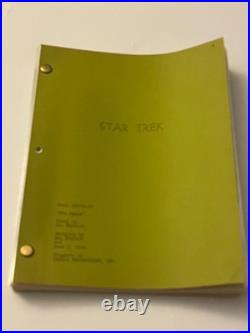
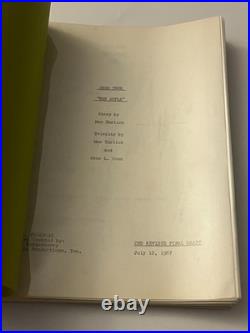
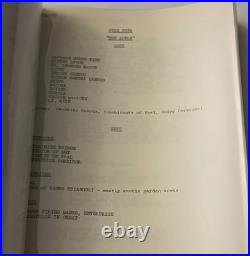
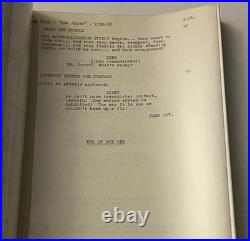
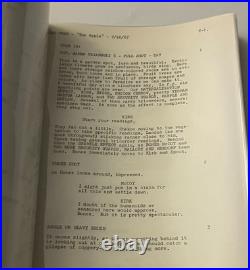
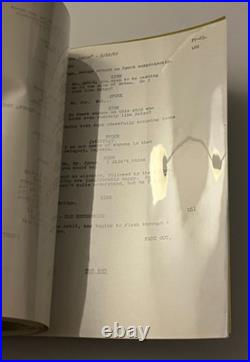
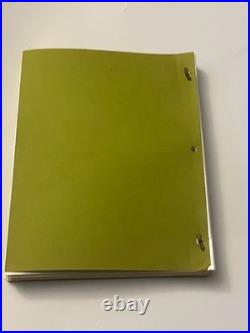

Star Trek TOS Script The Apple Desilu 1967 Max Ehrlich Gene L Coon Sci-Fi Classic. The previous owner had most of the scripts in a binder with plastic sleeves on all the pages. I’ve never seen that, but it was nice to preserve the pages from aging. I decided to keep the pages in the plastic to protect it when I transferred it out of the binder it came in. Someone contacted me and told me that the scripts I had were Lincoln Enterprise reprints. What an ORIGINAL Star Trek TOS Production Script Looks Like. These are working studio scripts created for cast/crew during production of Star Trek at Desilu Productions. Paper & Physical Construction (VERY IMPORTANT). Paper color: light cream to off-white. Paper stock: medium weight, slightly fibrous, not bright white. Two brass brads (top-left or top + bottom). Sometimes 3-hole punched with brass fasteners. Page size: US Letter (8.5 × 11). Typeface: Pica typewriter font (10 CPI). Printing method: typewritten or mimeograph. Ink: slightly uneven density (not laser-perfect). Scene headings and dialogue typed, not offset-printed. Front Cover (Key Tell). Plain heavy stock cover. Lower-left corner typically shows. “THE CITY ON THE EDGE OF FOREVER”. Series Created by: Gene Roddenberry. Scene numbers in margins. CONTINUED / CONTINUED ON NEXT PAGE. Act and scene breakdowns. Page numbers sometimes with letter suffixes e. Roddenberry Company REPRINTS (Vintage but NOT Production-Used). Starting in the late 1970s through 1990s, Gene Roddenberry authorized script reprints for. These are legitimate collectibles, but not original studio production scripts. No brass brads (often plastic comb or staple). Uniform ink density across all pages. Lacks Property of Desilu Productions, Inc. Some reprints copied original title pages exactly, which is why physical tells matter more than text. DEFINITIVE AUTHENTICITY CHECKLIST (Use This). ORIGINAL if MOST of these are true. Slightly uneven typewriter ink. Natural aging (edges, oxidation). REPRINT if ANY of these dominate. Identical ink density page to page. Analysis of YOUR Photos (Important). Based on what you provided. Brass brads (correct type and placement). Cream-colored paper with visible fiber. Property of: DESILU PRODUCTIONS, INC. Correct production number 6149-28. Correct revision dates (Feb 1967). Typewriter-style text with uneven ink. Scene numbering and CONTINUED formatting. FINAL DRAFT date matches broadcast timeline. What I do NOT see. No modern paper stock. So you can use these indicators to see if my post is accurate. According to ChatGPT it is. Star Trek: The Original Series. Original television production script (studio-bound, brass fasteners). 2nd Revised Final Draft – July 12, 1967. Story by: Max Ehrlich. Teleplay by: Max Ehrlich and Gene L. Original studio-issued production script from Star Trek: The Original Series for the episode The Apple. This example is the 2nd Revised Final Draft dated July 12, 1967 and produced by Desilu Productions during the show’s original network run. “The Apple” is a philosophically driven episode that explores themes of free will, obedience, and societal dependence on authority. Set on the planet Gamma Trianguli VI, the story examines a civilization controlled by a godlike machine named Vaal, raising moral questions about whether freedom and progress justify disruption of a seemingly peaceful society. The episode reflects Star Trek’s recurring engagement with ethical dilemmas and social commentary, using science fiction as a lens to critique authoritarianism and blind faith in technology. It also reinforces Captain Kirk’s recurring role as a challenger of imposed control, a theme that became foundational to the series’ identity. This script features period-correct formatting, typed dialogue, scene numbers, and revision markings consistent with late-1960s television production practices. The script is bound with original brass fasteners and bears Desilu Productions attribution, matching known studio-issued materials from the era. This item is a production script only and is not signed. Any visible markings or typography are part of the original printed production materials. Explores free will versus enforced order, a core Star Trek theme. Reflects 1960s cultural anxieties about authority and conformity. Written in part by Gene L. Coon, a key architect of Star Trek’s tone. Represents Star Trek’s philosophical science fiction approach. Regularly discussed in academic and fan analysis of the series. 1 If you have any questions feel free to contact me and I will try to get back to you as quickly as possible. It is a quick process. S will be free.